Citizen militia as a bulwark against tyranny
Federalist PapersCitizen militia as a bulwark against tyranny is the argument that an armed population, joined to locally rooted governments and officers, can resist a federal military establishment if it turns against the people. Its significance lies in the combination: arms supply capacity, while popular allegiance and state institutions supply organization, confidence, and political direction.
The Danger the Argument Answers
The argument addresses fears that the proposed federal government might accumulate military force and use it to destroy the state governments. It treats that danger as a chain of contingencies rather than as an immediate certainty: the people and states would have to elect a succession of officials willing to betray them; those officials would have to pursue a sustained plan to enlarge the military establishment; and state governments and citizens would have to watch the buildup without resisting it. The essay calls this scenario a product of extreme suspicion, yet proceeds to examine it on its own terms.
That willingness to grant the hypothetical matters. The claim is not simply that a federal army could never be formed. Even if a regular army were raised to the full measure of the country’s resources and placed at the federal government’s disposal, the essay argues, the states and people together would still possess the means to repel it. The militia’s role is therefore framed as a constitutional and political safeguard against a worst-case concentration of force, not as proof that the danger could not arise.
Arms, Numbers, and Local Allegiance
The essay compares the possible scale of a standing army with the population able to oppose it. Its estimate puts a country’s largest standing army at no more than one hundredth of its total population, or one twenty-fifth of those able to bear arms. Applied to the United States, that calculation yields an army of roughly 25,000 or 30,000 men, set against a militia of nearly half a million armed citizens.
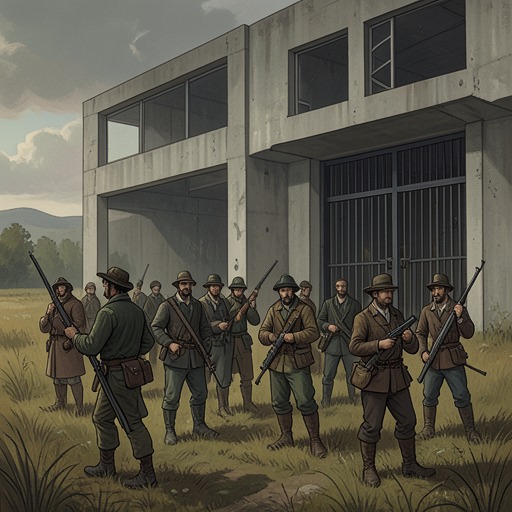
Numbers alone do not complete the argument. The militia members would be officered by people chosen from among themselves and would be fighting for liberties they shared. They would also be united and directed by state governments that possessed their affection and confidence. These connections make the force more than a collection of arms: local officers and trusted governments can organize citizens around common political commitments.
The essay accordingly treats the American advantage as both material and institutional. Americans possess arms, an advantage the text says people in almost every other nation lack. But the existence of subordinate governments to which citizens are attached, and which appoint militia officers, adds a barrier against ambition that a simple government cannot provide. The argument assigns no comparable protective combination to a population facing a centralized tyranny without these local structures.
The European Contrast and the Revolutionary Example
The comparison with Europe sharpens the point. European governments, despite maintaining military establishments as extensive as public resources permit, are described as afraid to trust their people with arms. The essay allows that arms alone might help those populations shake off their rulers’ power; it then emphasizes how much more formidable resistance could become if people also had self-chosen local governments able to gather public will and direct national force, together with militia officers appointed by those governments and loyal to both their communities and the militia.
The American Revolution supplies a precedent for resisting British arms. The essay invokes the country’s recent successful resistance and suggests that those most familiar with it would be least likely to believe that a militia under these circumstances could be defeated by a standing army of the projected scale. The precedent gives the numerical comparison a practical point of reference, while the argument’s focus on state governments and locally chosen officers explains why it sees American resistance as institutionally distinct from resistance in Europe.
Constitutional Safeguard, Not a License for an Experiment
The essay’s defense culminates in a refusal to treat resistance as something citizens should have to test after power has already consolidated. It calls on readers not to assume that free Americans would be less able to defend rights they actually possess than subjects under arbitrary rule would be to recover rights taken from them. At the same time, it warns against imagining that the people could be led into such a crisis through prolonged, quiet submission to a succession of deceptive measures.
The safeguard is thus preventive as well as defensive. State governments, popular confidence, arms, and locally appointed militia officers are presented as a network capable of frustrating usurpation before the people are reduced to a final trial of force. In the essay’s concluding logic, the federal government either remains sufficiently dependent on the people to avoid schemes hostile to its constituents, or it loses their confidence, in which case the state governments, supported by the people, can defeat those schemes.
Human Ambition and Institutional Design
This account of the militia belongs to a larger argument that government must be designed for human beings as they are, rather than for rulers presumed incapable of ambition. Elsewhere, the essays insist that government must be enabled to control the governed and obliged to control itself, because dependence on the people requires auxiliary precautions. The militia argument applies that logic across levels of government: federal force is checked not only by formal limits, but by the capacity of state institutions and their citizens to resist encroachment.
The broader historical comparisons in the work reinforce the need for such arrangements. The narrative attributes the ruin of the Athenian commonwealth in part to the private passions of Pericles, and describes Athens and Sparta turning from rivals into enemies after their victories over Persia, doing each other greater harm than they had suffered from Xerxes. It also recounts how a loose Greek confederacy left its members divided and vulnerable to Philip of Macedon. These examples make the militia’s institutional setting important: political safety depends on preventing ambition and division from leaving a community unable to defend its liberty.
The concept therefore joins popular arms to federal structure without treating either as sufficient in isolation. Its central image is a people whose capacity to defend themselves is strengthened by governments they trust and officers selected within their own communities. In that arrangement, the state governments are not merely administrative subdivisions; they are part of the proposed barrier against military despotism and the concentration of power.